
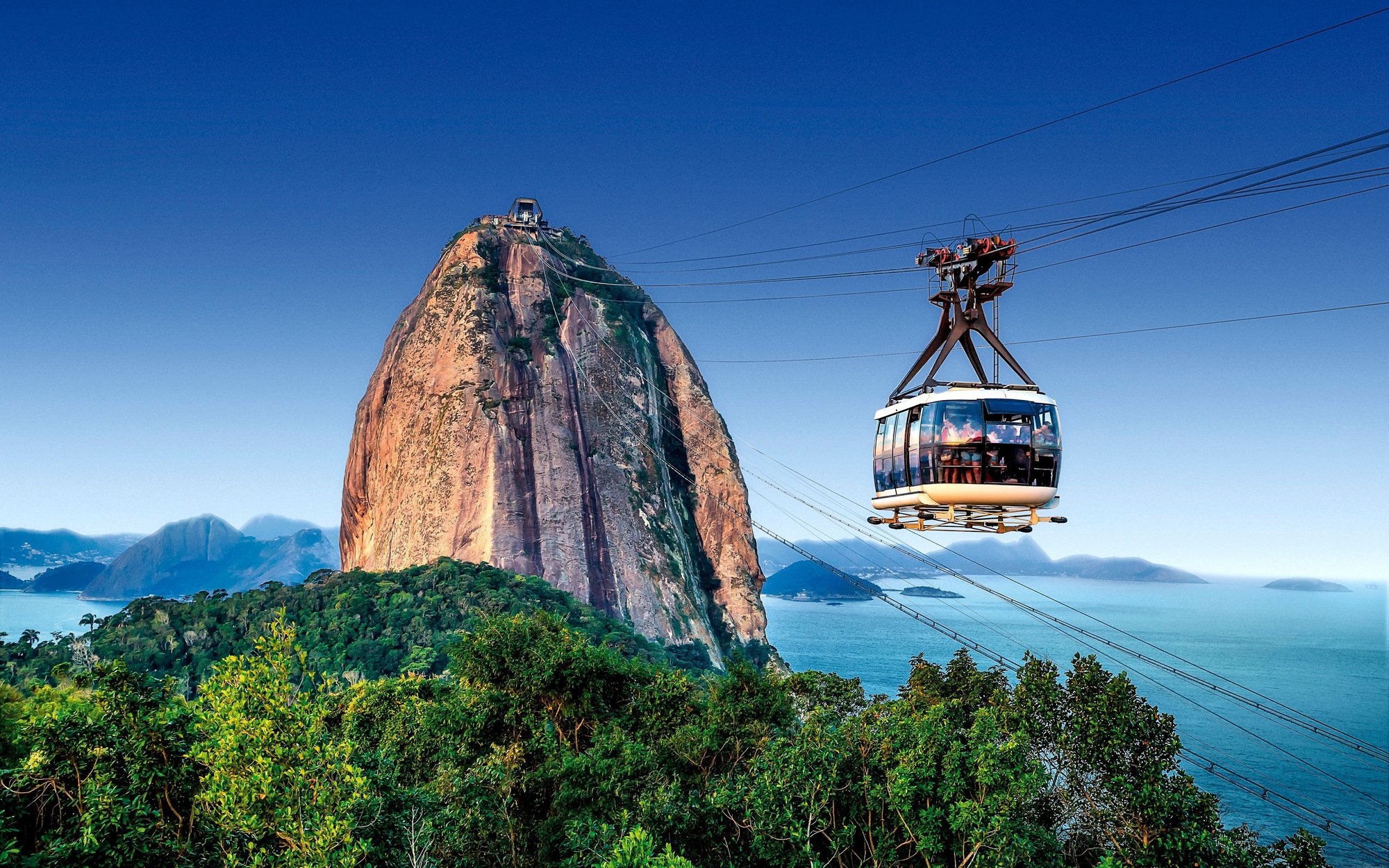
The first cabin leaves from a low station on Avenida Pasteur, a few steps from the sand of Praia Vermelha, and rises over the treetops to Morro da Urca before a second line carries on to the granite dome of Sugarloaf Mountain. Rio de Janeiro has had a cable car here since 1912, and Parque Bondinho Pão de Açúcar still runs the route in two stages, which shapes how long a visit takes and when it is worth going up.
This guide covers the practical side of the Sugarloaf Mountain cable car: which ticket to buy, how the time slots work, when the park opens, how to reach the lower station without a car and what there is to do on each hill. It also explains when it makes sense to walk part of the way and how the stations handle wheelchairs and pushchairs.
Two hills and two cable car lines
The ride starts at Praia Vermelha station in Urca. The first line, opened on 27 October 1912, covers 528 metres to Morro da Urca, a forested hill 224 metres high. The second, added in 1913, runs 735 metres from there to the top of Sugarloaf at 395 metres. A standard ticket includes four rides, up and down both sections, so you can break the journey at Morro da Urca in either direction.
A practical rhythm is to change cabins at Morro da Urca on the way up and keep its terraces for the return, when the light turns softer over Botafogo. The lower hill has more room, shade and food, while the summit is mainly about the view. The park itself suggests planning a whole day, and in good weather three or four hours pass quickly.
Sugarloaf Mountain cable car tickets
The standard Cable Car Ticket starts at R$205 and covers both lines in both directions, plus the free programming in the park. You choose a date and a time slot when you buy, and you cannot enter before that slot, so book a morning or late-afternoon window in advance rather than relying on the ticket office. Tickets are also sold at the office and at self-service machines on the day, payable in reais or by card, but popular slots can sell out.
Children up to two travel free. Half price applies to children aged 3 to 12, visitors aged 60 and over, young people aged 13 to 21 and students, including foreign students with a photo student card. Bring the document that proves the discount, because it is checked at the entrance. People born or living in Brazil have a separate promotional ticket and residents of Rio de Janeiro state pay R$89, but these offers cannot be combined with half price.
Up to 24 hours before your slot you can cancel or reschedule as often as you like, subject to availability. Within 24 hours you can reschedule once, or cancel with 20 per cent of the price withheld, and once your slot has started there is no refund. The QR code on your phone is scanned at every station, so turn the screen brightness up before boarding.
Two upgrades change the experience. The Fast Pass ticket gives priority boarding at every station and the use of an air-conditioned lounge at Praia Vermelha before the first ride. The Guided Tour adds a 50-minute walk with a bilingual guide in English and Portuguese, in groups of up to 20, starting at 9.30, 10.30 or 11.30 am. It covers the history of the cable car and the ecology of the two hills, and you can stay on afterwards without a time limit.
Opening hours and weather
The park currently opens at 8.30 am from Monday to Friday and at 7.30 am on Saturdays and Sundays, and closes at 9 pm, with last boarding at 7.30 pm. Hours have changed more than once, and the park’s own visitor FAQ asks you to check the website on the day of your visit.
The cable car keeps running in rain, and both hills have covered areas with shops and places to eat, but strong wind or lightning can pause the service until conditions improve. Low cloud over the bay hides much of the view, so if your dates allow, keep the visit flexible and go up on the first clear afternoon.
Time on Morro da Urca
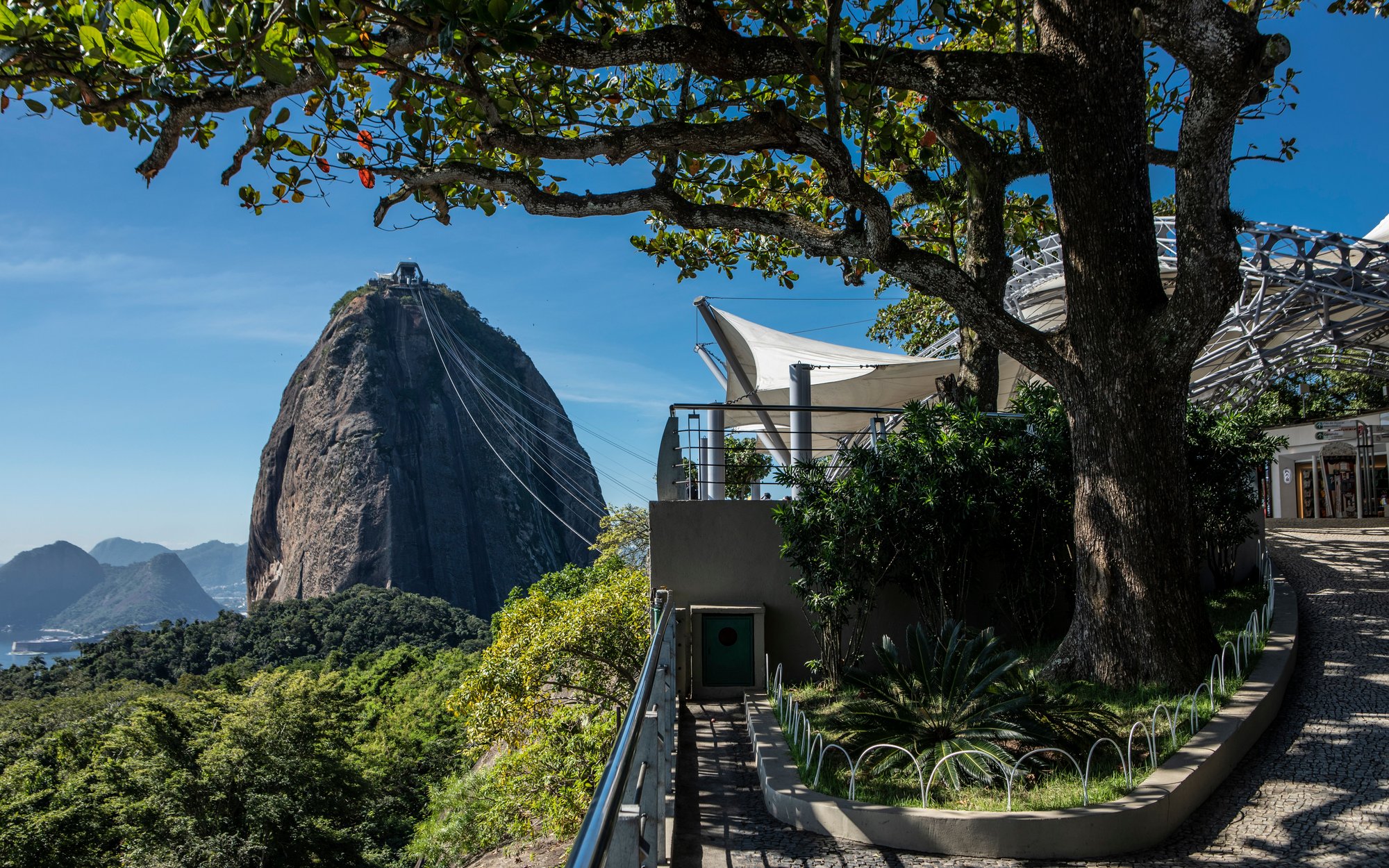
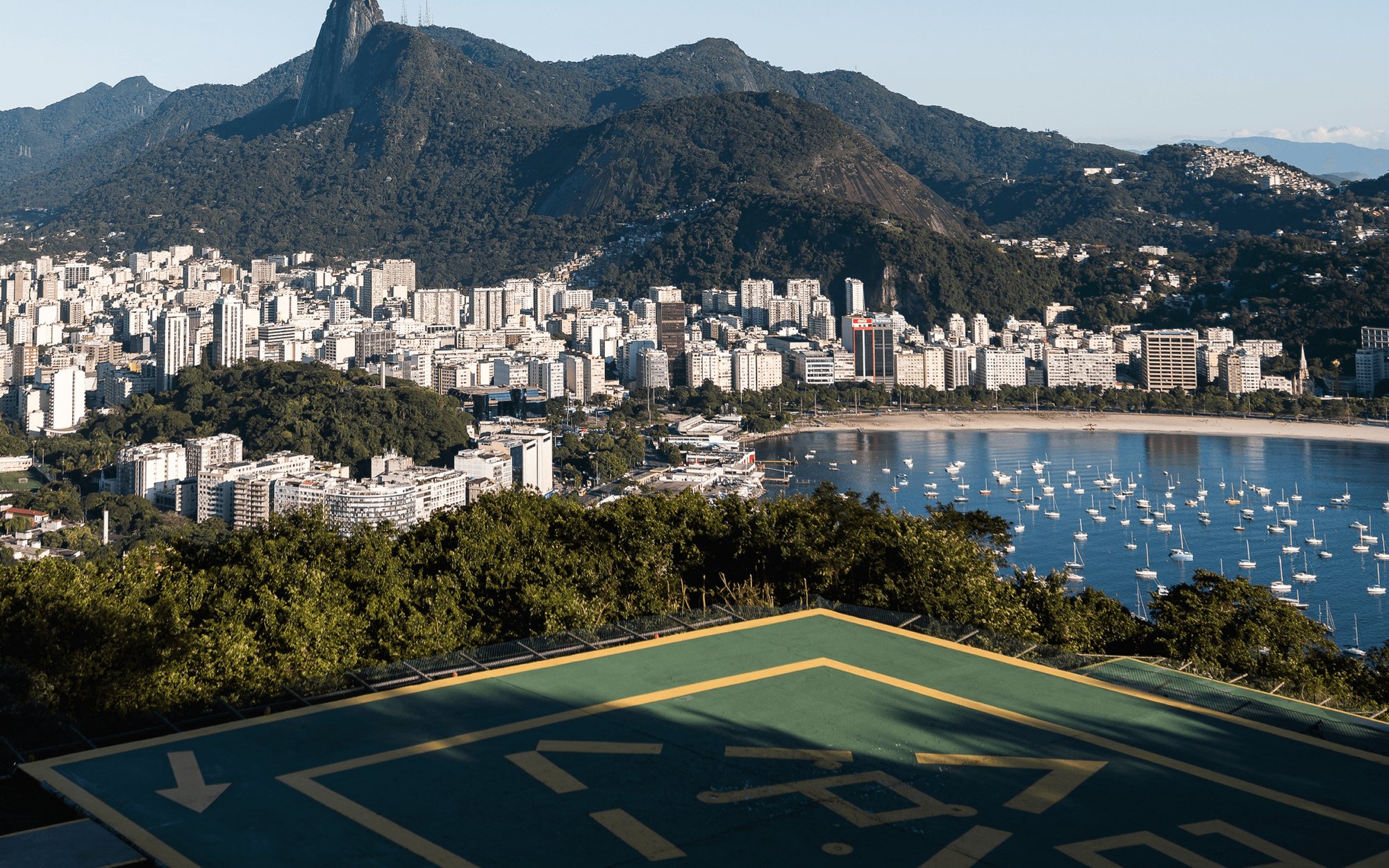
Morro da Urca is where the park keeps most of its facilities. There are viewpoints over Botafogo Cove and Guanabara Bay, restaurants and bars, shops with handicrafts and souvenirs, a children’s playground and the Jardim do Mel, a meliponary with hives of native stingless bees that forms part of the park’s work for the Atlantic Forest. The heliport on the same hill is the base for helicopter flights over the city, booked as an extra.
Along the paths runs the Historical Viewpoints Circuit, created with Brazil’s national heritage institute IPHAN in 2022, with information panels at 14 viewpoints across the park. Urca Hill also has a musical past: Noites Cariocas, a programme launched in 1980 and directed by Nelson Motta, turned it into a stage for new music and dance in the city.
On the summit of Sugarloaf Mountain
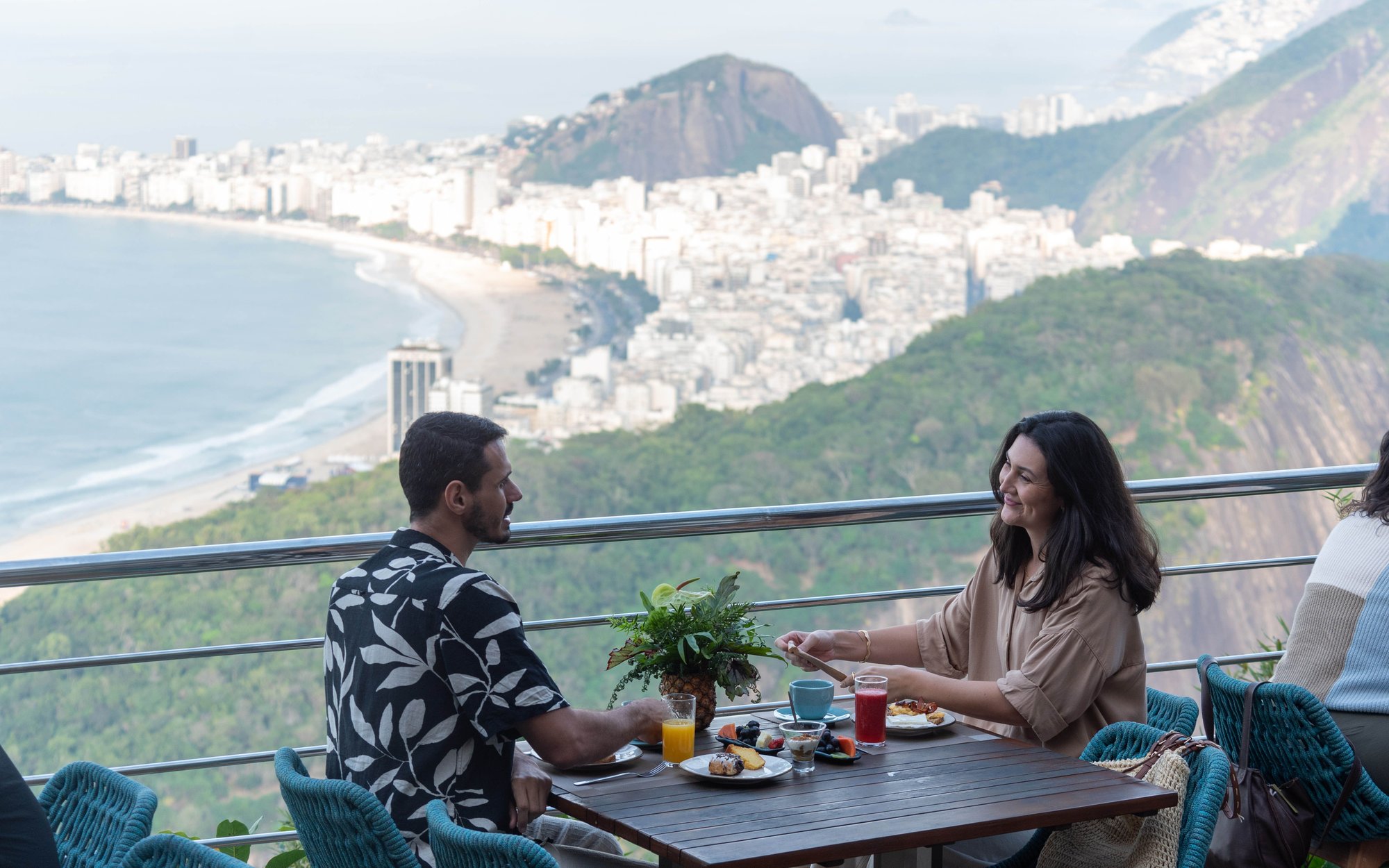
From the top, the panorama runs from the Tijuca Massif and Corcovado with the statue of Christ the Redeemer across Guanabara Bay and Botafogo Cove to the Serra do Mar, where the Dedo de Deus peak stands out on a clear day. On the ocean side, Copacabana curves away beyond Leme. This meeting of granite, forest, bay and city is why UNESCO inscribed Rio de Janeiro on the World Heritage List in 2012 as Carioca Landscapes between the Mountain and the Sea.
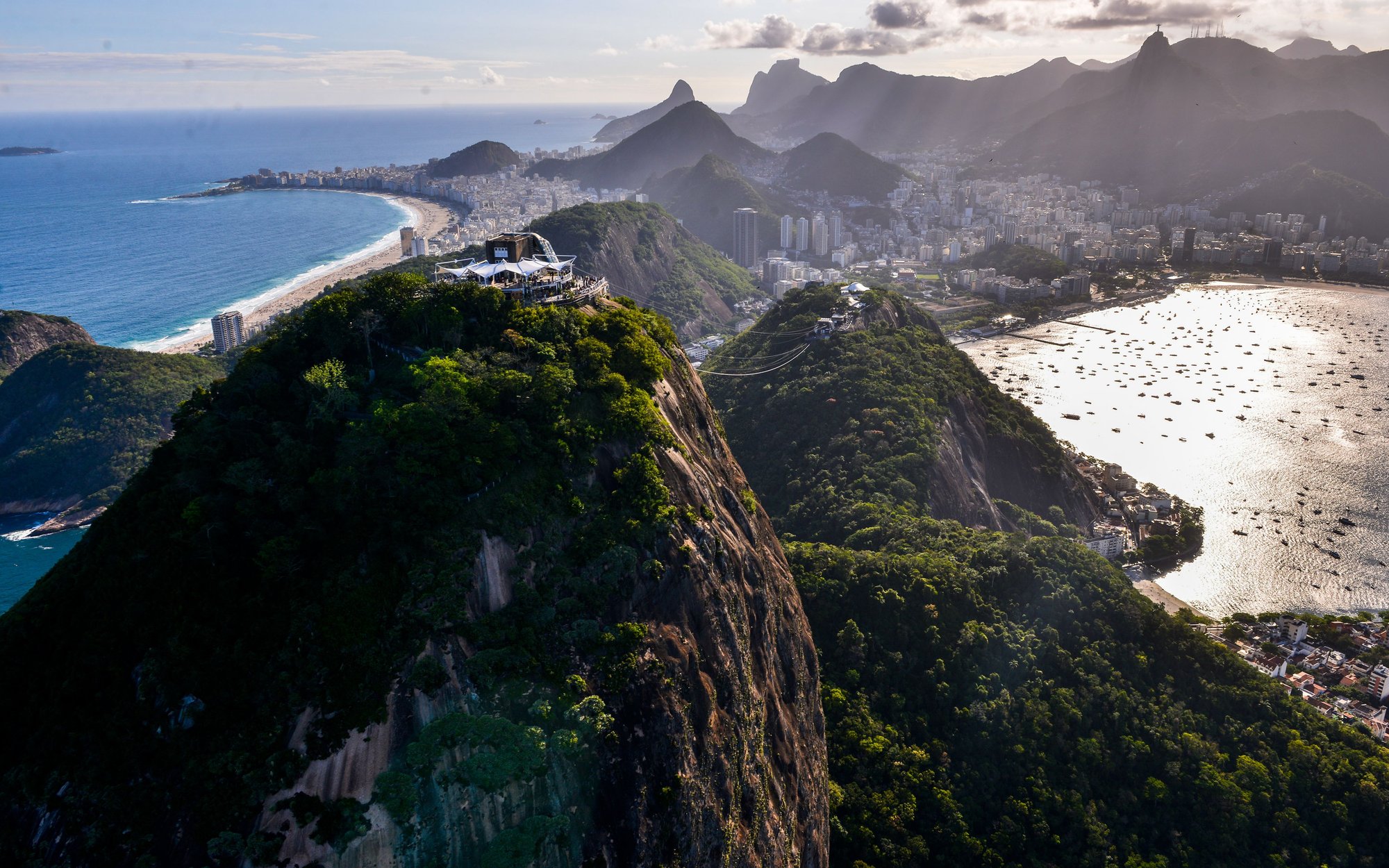
The summit also holds the Bosque das Artes, an open-air contemporary art space among the trees of the Atlantic Forest, where the current Project Wonder exhibition features work by Anna Bella Geiger. It is included in the ticket and open from 9 am to 5 pm from Monday to Thursday and from 8.30 am to 5 pm from Friday to Sunday. The Clássico Sunset Club restaurant is up here too, with a panoramic view over the city.
Sunset and sunrise above the bay
Late afternoon is the classic time to ride up. On selected dates the park holds a sunset session with a DJ, included in the ticket, and announces the programme on its website and social media.
For an earlier start, Sunrise at Parque Bondinho lets you into the park before it opens to the public to watch the dawn to the sound of a saxophone, followed by breakfast at the Clássico Sunset Club from 6 to 8 am. It must be booked at least a day ahead, by 5.30 pm, the start time moves with the sunrise and is printed on the ticket, and the session can be cancelled in bad weather. Arriving late without notice counts as a no-show.
More than a century of the Bondinho
The cable car was conceived by the Brazilian engineer Augusto Ferreira Ramos, and about 577 passengers rode the first section on its opening day in 1912. In 1972 new bubble-shaped cabins with transparent side panels took over, raising capacity from 115 to 1,360 passengers an hour. The current cabins came from Switzerland in 2008 with the same design, a digital system and safety panels that monitor wind and brake pressure.
In 1973 IPHAN listed the Sugarloaf complex, formed by the Sugarloaf, Urca, Cara de Cão and Babilônia hills, as part of Brazil’s heritage. More than 50 million visitors have made the trip, and the park’s history page traces the milestones from the 1912 opening to the new drive pulleys of 2021, which made the ride faster.
Walking up Morro da Urca
If you would rather earn part of the view, the trail up Morro da Urca takes about 30 minutes uphill and is graded light to moderate. It is reached from the Pista Cláudio Coutinho, a free path at the foot of the hills beside the army command school on Praça General Tibúrcio at Praia Vermelha. The Monumento Natural dos Morros do Pão de Açúcar e da Urca, the municipal conservation unit that protects both hills, gives the path’s opening hours as 6 am to 6 pm daily.
The park gate at the top of the trail opens at 9 am and closes at 5 pm every day. Walkers then buy a cable car ticket to continue: R$130 for the ride up to Sugarloaf with the descent included, or R$55 to ride down from Morro da Urca to Praia Vermelha, with half-price fares of R$65 and R$27. Start the climb early enough to reach the gate before it closes.
Getting to Praia Vermelha station
The lower station is at Avenida Pasteur 520 in Urca. The park has no car park of its own, but tickets bought on the official website give a rate of R$20 for up to six hours at the Rio Sul shopping centre garage on the same day. By metro, ride to Botafogo station, take exit E (Mena Barreto) and walk to the last stop of bus 513 on Rua Voluntários da Pátria; get off at UNIRIO, about 260 metres from the park. Bus 107 from Central via Flamengo, and lines 518 and 519 between Urca, Botafogo and Copacabana, are the other main routes.
There is no bike rack, but the park suggests leaving bicycles, with your own lock, near the newsstand in front of the Árabe da Urca restaurant, and there is an Itaú bike-share dock just before the entrance.
Access rules and accessibility
Read the park’s access rules before you leave the beach. Bags larger than 25 x 35 x 55 cm, tripods, drones, beach chairs and umbrellas, coolers and glass containers are not allowed, and nor is entering in swimwear, shirtless or barefoot. Food must be in sealed packaging, nothing may be eaten or drunk inside the cabins, and children under 16 must be accompanied by a parent, legal guardian or adult relative with proof of the relationship.
For visitors with reduced mobility, the stations have eight platforms or lifts between them: two at Praia Vermelha and three each on Morro da Urca and Sugarloaf. Morro da Urca also has a green access route called Via Verde and an inclined access built by the park in 2016. A wheelchair is available at each station, subject to availability, and there is a single parking space for wheelchair users. The park lists the Time Capsule on Morro da Urca and the Clássico restaurant on the summit as not yet accessible, and reaching the Bosque das Artes also involves stairs. Pushchairs are allowed.
Fitting Sugarloaf into a few days in Rio
Sugarloaf pairs well with a morning at Corcovado, as each summit looks across at the other. Our guide to things to do in Rio de Janeiro explains how to plan the visit to Christ the Redeemer, whether by the Corcovado train from Cosme Velho or another authorised route, and how to group the beaches and port-area museums around it.
If you are staying on the beach, the Copacabana Palace keeps Urca within easy reach, and the cable car makes a fitting last evening before flying on to the Iguaçu Falls on the Brazilian side. Whichever day you choose, check the sky over the bay in the morning, book a slot about two hours before sunset and wait for the city lights before taking the last cabin down.