

Restaurant status checked on 7 November 2026: current listings mark the historic Kárpátia at Ferenciek tere 7–8 in Budapest as closed. Hungarian reports documented its closure in 2021, and a December 2025 report still described it as awaiting a new tenant. This is an archival article about the restaurant and its interiors, not a current booking recommendation.
For the status context, see the 2021 closure report and Magyar Nemzet’s December 2025 account. Do not use the former event capacities below as a current offer of dining or venue hire.
Kárpátia’s history in the Franciscan Bazaar
In the year 1877, in the freshly built Franciscan Bazaar György Holzwarth leased a restaurant and appointed – wisely – Károly Csalányi as manager. The restaurant quickly became popular with Budapest citizens, often the line of those waiting for a table stretched as far as the Franciscan church. The famous restaurateur dynasty, the Spolarich family bought the place in 1925 and transformed it into its present, atmospheric and unique state with the help of celebrated artists of the day.
The rebuilding of the rooms began in 1926 according to the plans of Károly Bodon, with the inner salons decorated in romantic style, complete with paintings depicting battle scenes and events of the heroic Hungarian history. The walls are handpainted, with gilded decoration and arches reminiscent of gothic times. All of the works of art are masterpieces by Hungarian artists: including paintings by Lajos Pándy and Károly Reischl, as well as sculptures by Henrik Kollátor.
In 1934 László Károlyi leased the restaurant, gathered a wide range of recipes and changed its name to Kárpátia.
Kárpátia became state property in 1949 and part of HungarHotels chain in 1957. By proposal of the Museum of Gastronomy and the Museum of Applied Arts the Minister of culture declared the interior decoration and furniture a National Heritage. The restaurant was renovated in 1979. In the year 1997, Dr. Ákos Niklai purchased the restaurant.
The historical account above describes successive owners and changes to the restaurant. The Hungarian National Archive also records these milestones in its Kárpátia photographic archive.
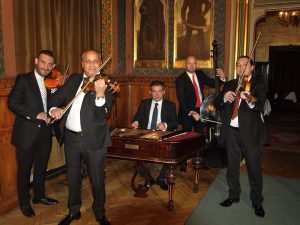
Interiors and music: the former dining experience
Kárpátia was known for hand-painted and gilded walls, historical paintings and live music alongside Hungarian cooking. The photographs retained here document that earlier dining setting. They do not establish current access to the interior or a present-day music programme.
The former restaurant advertised 260 indoor seats and a summer terrace with up to 150 places. These figures are preserved as historical information about the venue, not as current booking capacity.
Historic rooms and former event layouts
Music room
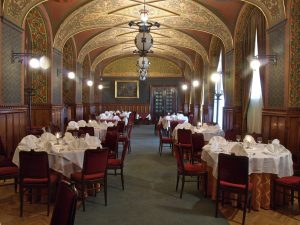
Former banquet seating: max. 80 pax
(6-8 pax at one table)
The Music Room could include two side rooms, the
advertised maximum capacity was 140 guests (with 6-8 pax
at one table). These rooms could be separated
as private rooms.
Room Vitéz

Former banquet seating: max 32 pax.
(6 – 8 pax at one round table)
Max 18 pax at one long table.
Room Zrínyi

Former banquet seating: max 44 pax
(6-8 pax at one table)
(with round tables max 32 – 36 pax)
Kárpátia Saloon
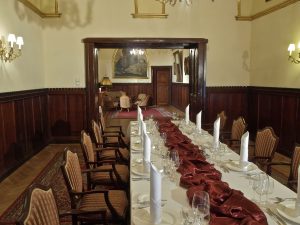
Former banquet seating max. 40 pax.
(6-8 pax at one round table)
Max 22 pax at one long table.
Former catering services
The restaurant previously promoted off-site catering and event organisation. That historic service should not be treated as currently available.
Historic location
Kárpátia occupied premises at Ferenciek tere 7–8, 1053 Budapest, Hungary. The former booking telephone, email and website have been removed from this archive to avoid presenting them as working reservation channels. If a future operator announces a reopening, confirm that it is this Budapest address rather than another restaurant with the same name.