
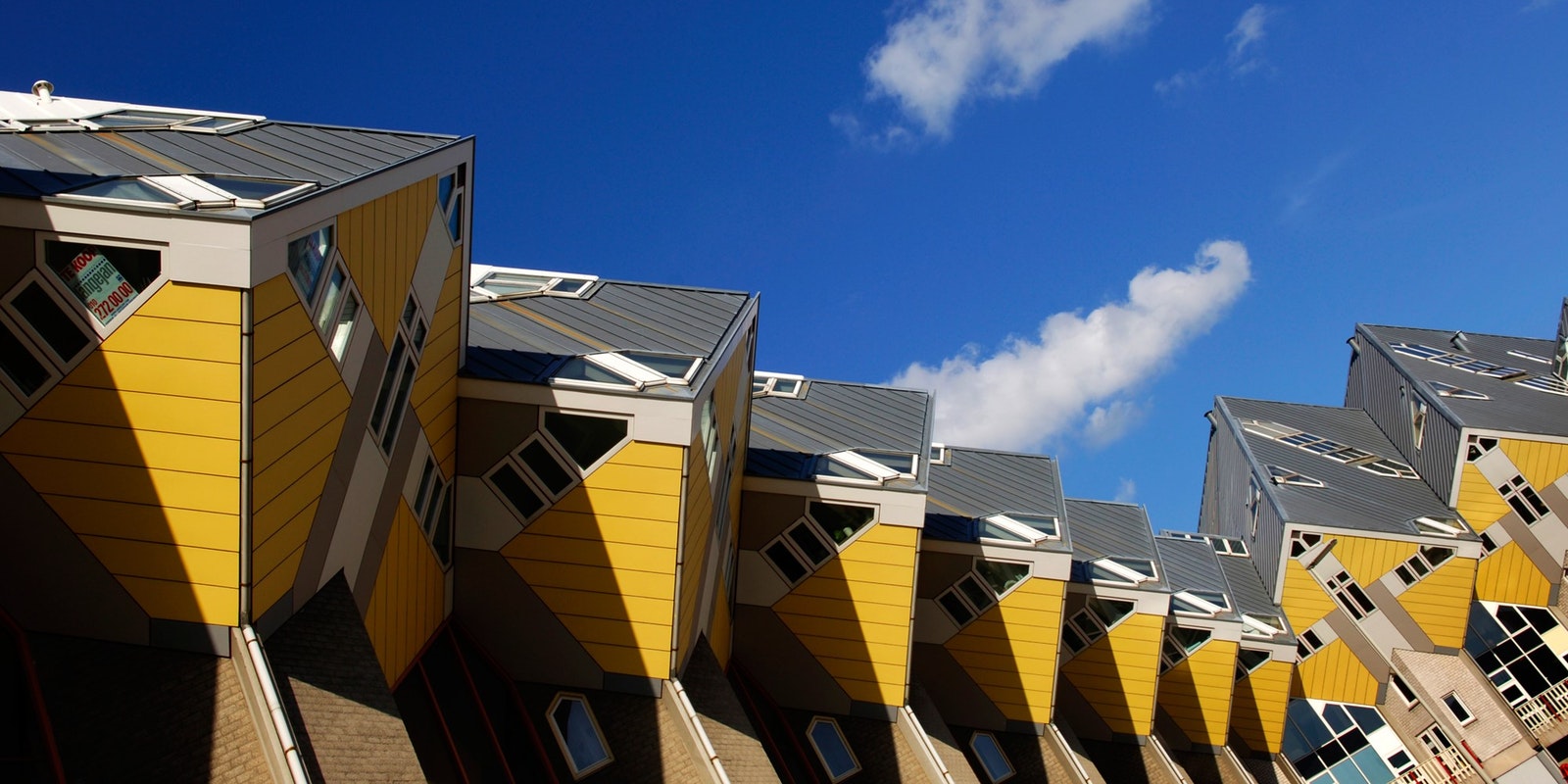
Rotterdam’s Cube Houses turn a familiar domestic shape into something disorienting: yellow walls tilt towards the street, roofs point in unexpected directions, and the space between the houses becomes part of the architecture. Piet Blom’s village-within-a-city idea is more than a photograph. The Kijk-Kubus museum house offers a way to see how rooms work inside those sloping walls.
Originally published in 2019. Visitor information checked on 10 November 2026; the original photograph is retained.
Piet Blom’s Blaakse Bos
The architect imagined individual houses as trees and the development as a wood, hence the name Blaakse Bos. The tilted cubes rise above a pedestrian-level setting near Rotterdam Blaak and the Oude Haven. The museum’s official questions and answers date construction to 1982–1984 and identify Piet Blom as the architect.
These are homes as well as a landmark. The furnished Kijk-Kubus is the designated museum house for visitors, rather than an invitation to explore private residences. Its appeal lies in the small decisions that a sloping wall demands: where furniture can stand, how light enters, and how one floor connects to the next.
Inside the Kijk-Kubus museum house
The museum’s English information describes three floors connected by steep stairs. That matters more than the building’s playful exterior if climbing is difficult. Check access with the museum before travelling if you need a step-free visit; do not assume that an ordinary house entrance means an accessible interior.
Opening times and the surrounding neighbourhood
As checked on 10 November 2026, the official site lists daily opening from 10:00 to 18:00 and standard admission of €3.50, paid on arrival by cash or card. This replaces the older 11:00–17:00 hours in this feature. Check the official page again for holiday or seasonal changes before setting out.
The museum address is Overblaak 70, Rotterdam. Blaak station, the Markthal and the Oude Haven are nearby, making the Cube Houses a natural pause during a walk through this part of the centre. Allow time to look at the cluster from below as well as inside: the relationship between the cubes is as distinctive as any single room.